
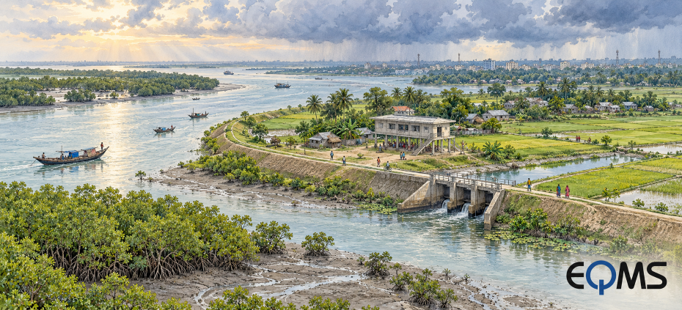
What should a coastal embankment be designed to withstand
decades from now? The new emissions pathways for the seventh phase of the
Coupled Model Intercomparison Project (CMIP7) will help explore that question.
They will inform the IPCC’s next assessment cycle, but they describe
conditional futures—not forecasts or probabilities. For Bangladesh and the
wider Global South, their value lies in better decisions under uncertainty. [1]
From CMIP1 to CMIP7
The Coupled Model Intercomparison Project has evolved
substantially since it was established in 1995. The early CMIP phases were
primarily designed to compare how different climate models responded to common,
idealised forcings. CMIP1 and CMIP2, for example, included experiments in which
atmospheric CO₂ increased by 1% per year under controlled conditions. As the
project matured, its scenarios became increasingly connected to plausible
socioeconomic and energy futures. CMIP3 supported the scenario framework used
for IPCC AR4, followed by CMIP5 and its Representative Concentration Pathways
(RCPs), which linked emissions and land-use assumptions to specified
radiative-forcing levels. CMIP6 then introduced the Shared Socioeconomic
Pathways (SSPs), combining socioeconomic storylines with different emissions
and forcing trajectories. [1]
CMIP7 represents another step in this evolution. Rather than
simply extending the CMIP6 framework, the new ScenarioMIP design attempts to
reflect what is now known about the direction of energy systems, technologies,
emissions and climate policy. It also responds to a changing real world: some
of the highest CMIP6 pathways now appear less plausible given the rapid
expansion and falling costs of renewable technologies, while some of the most
stringent low-emissions pathways are increasingly difficult to achieve without
substantial carbon dioxide removal. [1,2]
What has changed
One of the clearest changes is the treatment of climate
policy. CMIP6 scenarios were commonly discussed through labels such as
SSP1-2.6, SSP2-4.5 and SSP5-8.5, in which socioeconomic storylines were paired
with radiative-forcing levels. CMIP7’s seven marker scenarios are named more
directly according to their emissions trajectories: High (H), High-to-Low (HL),
Medium (M), Medium-to-Low (ML), Low (L), Very Low (VL), and Low-to-Negative
(LN). [1]
The new framework also removes the old idea of a generic “no
climate policy” baseline. Instead, the scenarios explore different directions
from the policy landscape observed in 2025. The Medium pathway represents a
world in which officially implemented climate policies continue at
approximately their existing level. Importantly, it does not automatically
assume that all announced Nationally Determined Contributions (NDCs) or
long-term net-zero targets will be achieved unless they are supported by policies
that are in place. The Medium pathway is therefore a benchmark for
current-policy conditions. [1,2]
Other pathways explicitly examine policy strengthening,
delayed mitigation and policy reversal. The High scenario explores a plausible
weakening or rollback of mitigation policies. High-to-Low considers a future in
which emissions remain relatively high for much of the century before strong
mitigation produces rapid reductions later. Medium-to-Low represents delayed
strengthening of mitigation. The Low, Very Low and Low-to-Negative scenarios
explore increasingly stringent mitigation, including different degrees of
temperature overshoot and subsequent carbon dioxide removal. [1]
Another important change is that socioeconomic storylines
have not disappeared. Shared Socioeconomic Pathways remain widely used, and
CMIP7 marker scenarios continue to draw on SSP-based socioeconomic and
technological assumptions because these provide established demographic,
economic and technological quantifications. However, the CMIP7 framework is
more flexible: the same emissions trajectory can, in principle, be associated
with different socioeconomic developments, rather than implying that a particular
emissions outcome has only one underlying social or economic future. [1]
The scenarios also incorporate a stronger consideration of
recent technological and energy-system trends. Their plausibility is informed
by developments such as renewable-energy deployment, technology costs, observed
emissions trends and the changing structure of the global energy system. This
is one reason the new High pathway is substantially lower than the most extreme
CMIP6 pathways such as SSP5-8.5. This reflects a reassessment of which
emissions trajectories remain plausible given current knowledge. [1,2]
Finally, CMIP7 extends the scenario framework much further
into the future. The seven scenarios are extended beyond 2100 to 2500, allowing
researchers to examine long-term warming stabilization, delayed mitigation and
overshoot trajectories over centuries. This is especially relevant for
slow-response systems such as sea level, glaciers, groundwater and coastal
infrastructure, where impacts can continue long after annual greenhouse-gas
emissions have changed direction. [1]
For Bangladesh, this evolution matters because climate-risk
assessment is no longer simply a question of selecting one emissions pathway.
It increasingly requires testing how infrastructure and natural systems perform
across different combinations of policy, socioeconomic development, technology,
emissions and climate response.
What this means for Bangladesh
For a low-lying delta, a lower central estimate in the
highest emissions pathway does not remove the need for robust adaptation. Sea levels
can continue rising for centuries after global temperature stabilizes. [4]
Coastal assessments should therefore examine embankments, storm surge, drainage
and salinity together. Urban studies should test rainfall extremes alongside
blocked drainage, changing land use and exposure. Local river flows, tides,
subsidence and water management matter: a global temperature estimate alone
cannot determine flood depth or salinity at a project site. Project or site-specific
assignments should be taken on a priority basis.
Lessons across the Global South
Regional risks differ. Nepal needs assessments that connect
glacier change and mountain hazards with downstream water supply and
hydropower. African countries require locally specific analysis of heat,
rainfall, agricultural livelihoods and water availability. [3] Carbon-removal
proposals also need scrutiny: land-based approaches can compete with food
production and water use. Community rights and local benefits should shape
project choices, rather than treating land and water as an unlimited resource.
[3]
A clearer basis for action
CMIP7 will expand the evidence available to planners; it
does not make a single warming outcome certain. EQMS Consulting Limited
supports environmental assessment, climate-risk analysis, water-resource
management and nature-based solutions that translate evolving science into
locally relevant plans.
References
[1] Van Vuuren, D. P., et al.
(2026). The Scenario Model Intercomparison Project for CMIP7
(ScenarioMIP-CMIP7). Geoscientific Model Development, 19, 2627–2656. doi:10.5194/gmd-19-2627-2026
[2] Hausfather, Z. (2026, 1
September). Explainer: The CMIP7 emissions scenarios—and how they explore
future climate change. Carbon Brief
[3] IPCC (2022). Climate
Change 2022: Impacts, Adaptation and Vulnerability. Chapters 9 and 10; Summary
for Policymakers. Report
[4] IPCC (2021). Climate
Change 2021: The Physical Science Basis. Summary for Policymakers, section B.5.
Summary
Share this page via